

There is no tree without knots.
There is no wood without character
Wood does not grow straight.
If the sun shines from the south, branches extend to the south; if the wind blows continuously, it leans downwind; if it stands on a slope, the base bends. Inside the trunk, the fibers twist loosely, and that twist remains even after felling.
Even seemingly straight trees all have their own character.
---
Assembling without correcting
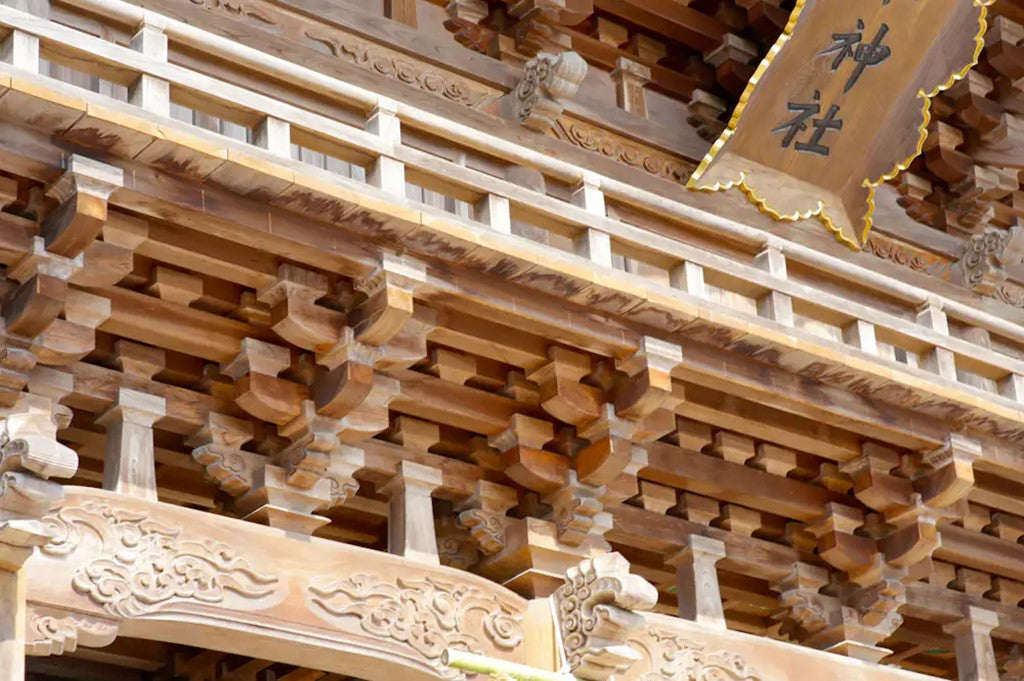
Tsunekazu Nishioka, the master carpenter who rebuilt Horyuji Temple, repeatedly spoke about the character of wood. His philosophy, as it has been passed down, is this: you don't correct the character of wood to use it. Instead, you align the characters against each other, assembling them in such a way that they cancel each other out.
You combine a piece of wood that twists to the right with one that twists to the left. You pit a force that wants to warp against another force that wants to warp. Then, even as both pieces try to move, the whole remains still. It's not being restrained; it's in balance.
This approach, called Kusagumi (character-joining), is said to be one of the reasons why the building has stood for over a thousand years.
What's interesting is that character is not treated as a defect. The character is a record of where the wood grew and what kind of wind it received; if you erase it, you erase the very foundation of its strength. Therefore, it is not corrected.
There is also an oral tradition that says, "Use wood according to its orientation." Wood that grew on the south side of a mountain should be used on the south side of a building, and wood that grew on the north side on the north side. The idea is that if you place the wood in the same orientation as its growing environment, it will settle down obediently.
---
Slab tables move
From here, we'll talk about our work.
A slab table is a large, thick board sawn from a log. Because it is wide, it will expand when it absorbs moisture and shrink when it dries. For a board one meter wide, this movement can amount to several millimeters over the course of a year.
This movement cannot be stopped. If you try to stop it by fixing the tabletop with metal hardware, the wood loses its escape route and will crack.
So, instead of restraining it, we allow it to move.
There is a method called "Suitsuki-zan" (dovetail battens). A groove is carved into the underside of the tabletop, and a trapezoidal batten is slid into it from the side. The batten supports the warpage of the tabletop but is not glued. When the wood expands and contracts, the tabletop can slide a few millimeters along the batten.
For the hardware connecting the legs to the tabletop, we make long holes instead of round ones. This is to allow the bolts to move within the holes.
**Instead of preventing movement, we design it so that it won't break even if it moves.** What we're doing is the same as Kusagumi.
---